Every AI tool forgetsyourproduct the moment you close the tab.
The operating system for product work. Product f() doesn't forget. It is an AI Product Operating System that remembers your product, your data, and every decision your team has made, so every answer starts where you left off, and every action is one you can trust.
Early access. No spam.
One memory across every functionConfidence routed to humansEvery answer carries its sources
// product shots
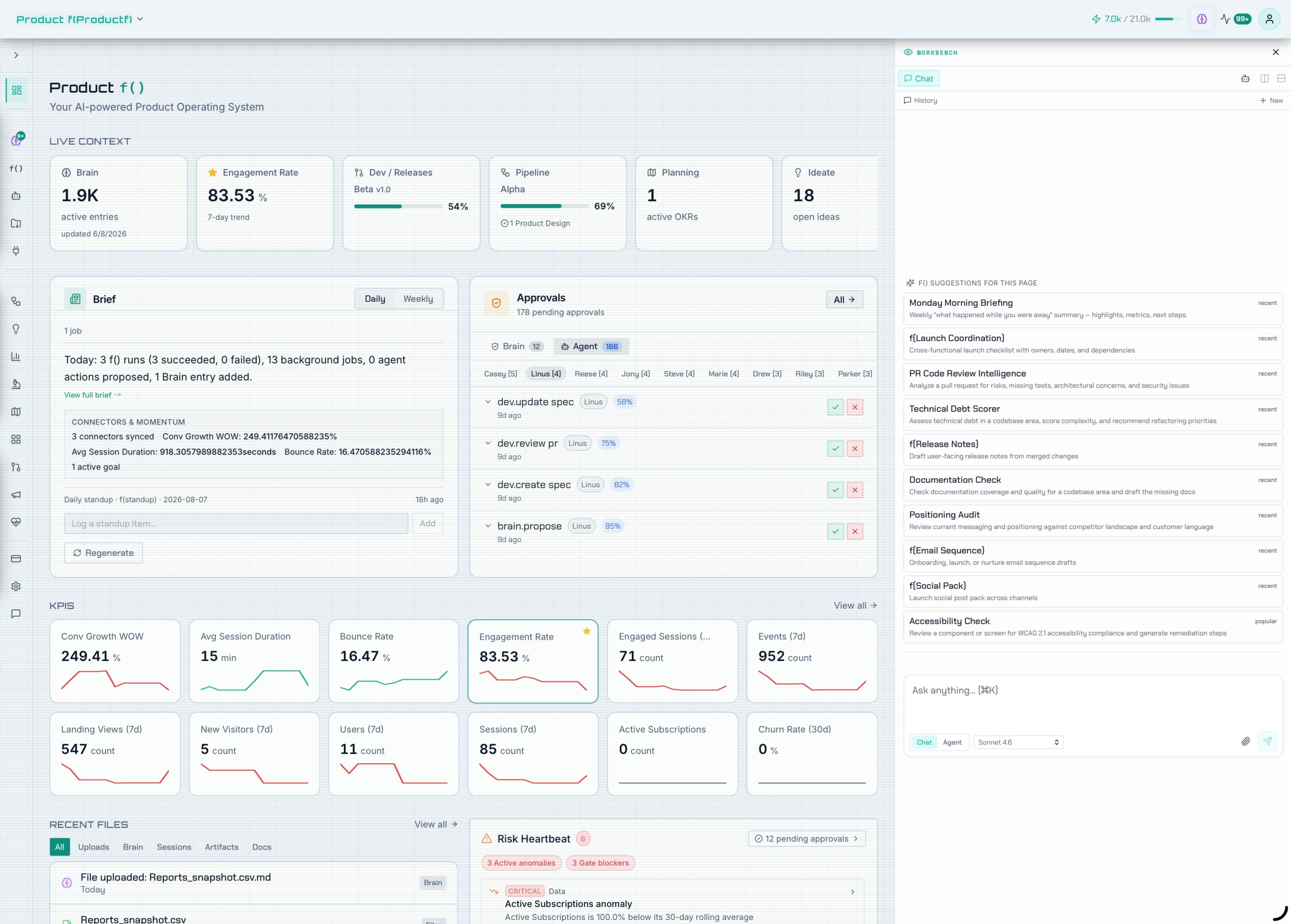
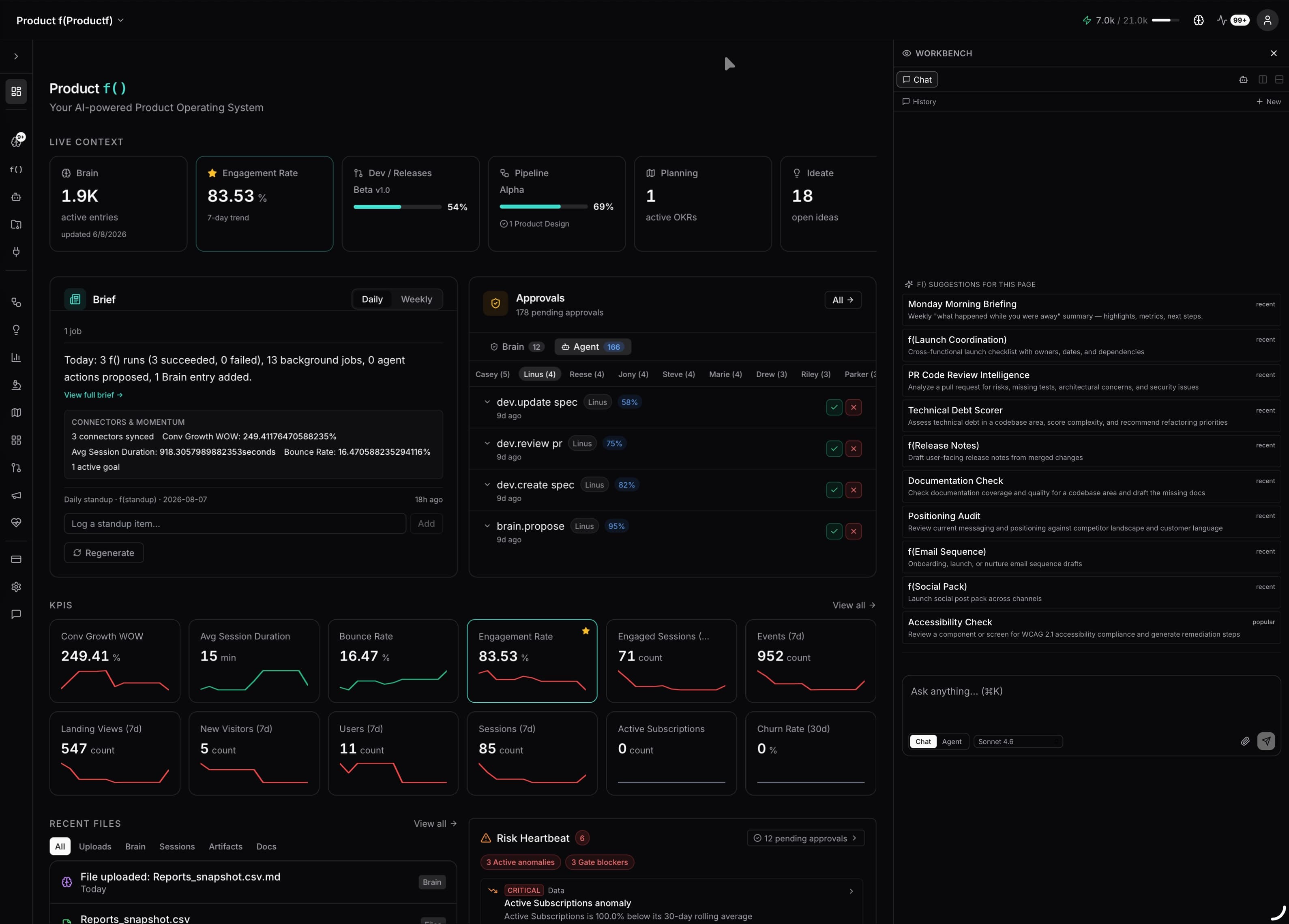
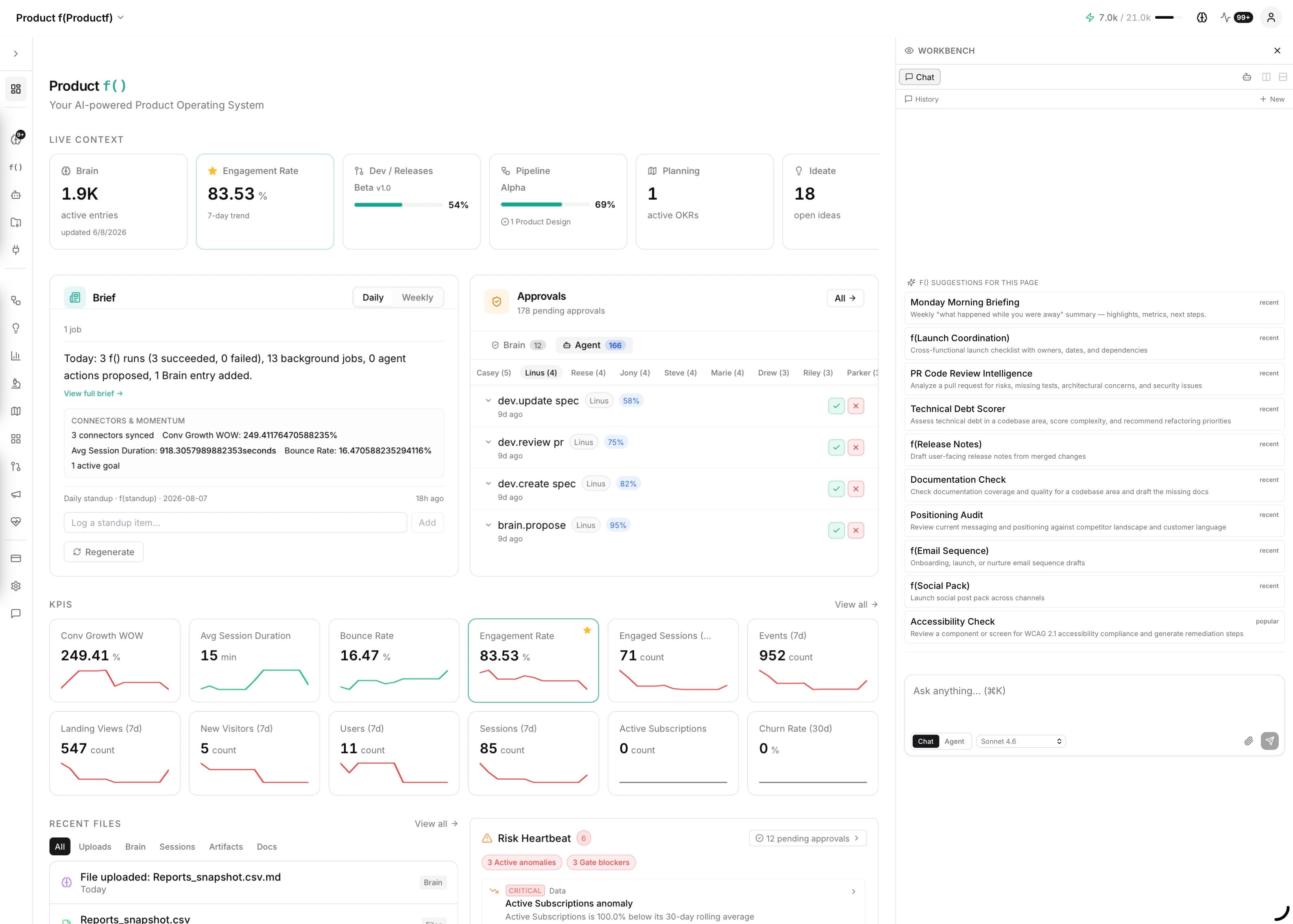
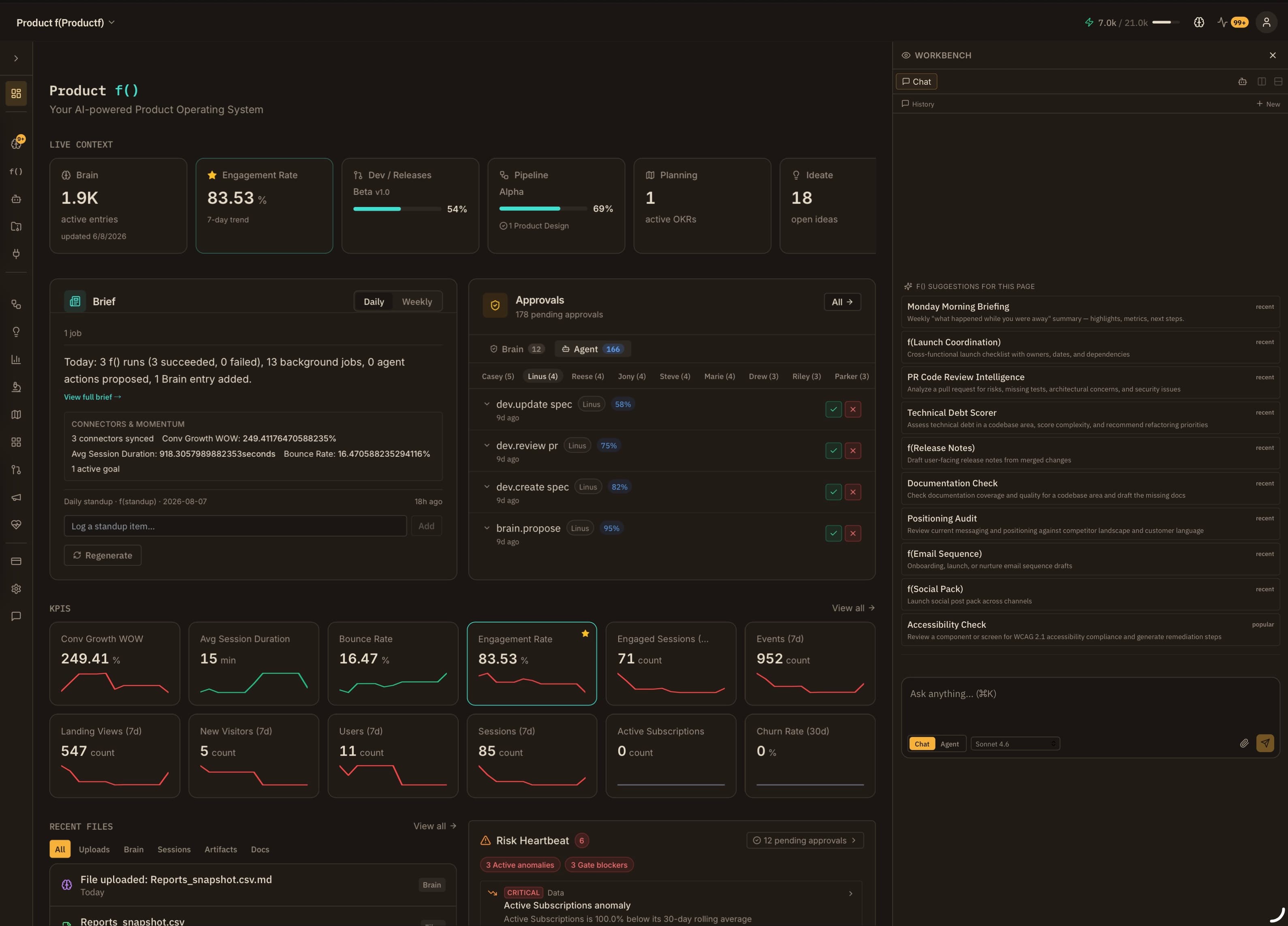
A working product, not a concept.
Real surfaces from the private beta. Swipe through the workspace, then see how the Brain and functions connect it all.
WorkbenchAsk, plan, or run - with your choice of model and the approval gating you set. Comment inline, share the chat, and view almost anything without leaving the thread.
Chat ModesAsk, Plan, or Run - with Review All, Review Exceptions, or Allow All gating on Run.
ModelsAnthropic, OpenAI, Gemini, xAI, Meta, Mistral, DeepSeek, Moonshot, Alibaba - plus Free and Auto modes.
Chat SharingPrivate by default, or shared within the workspace or externally by email to view or chat.
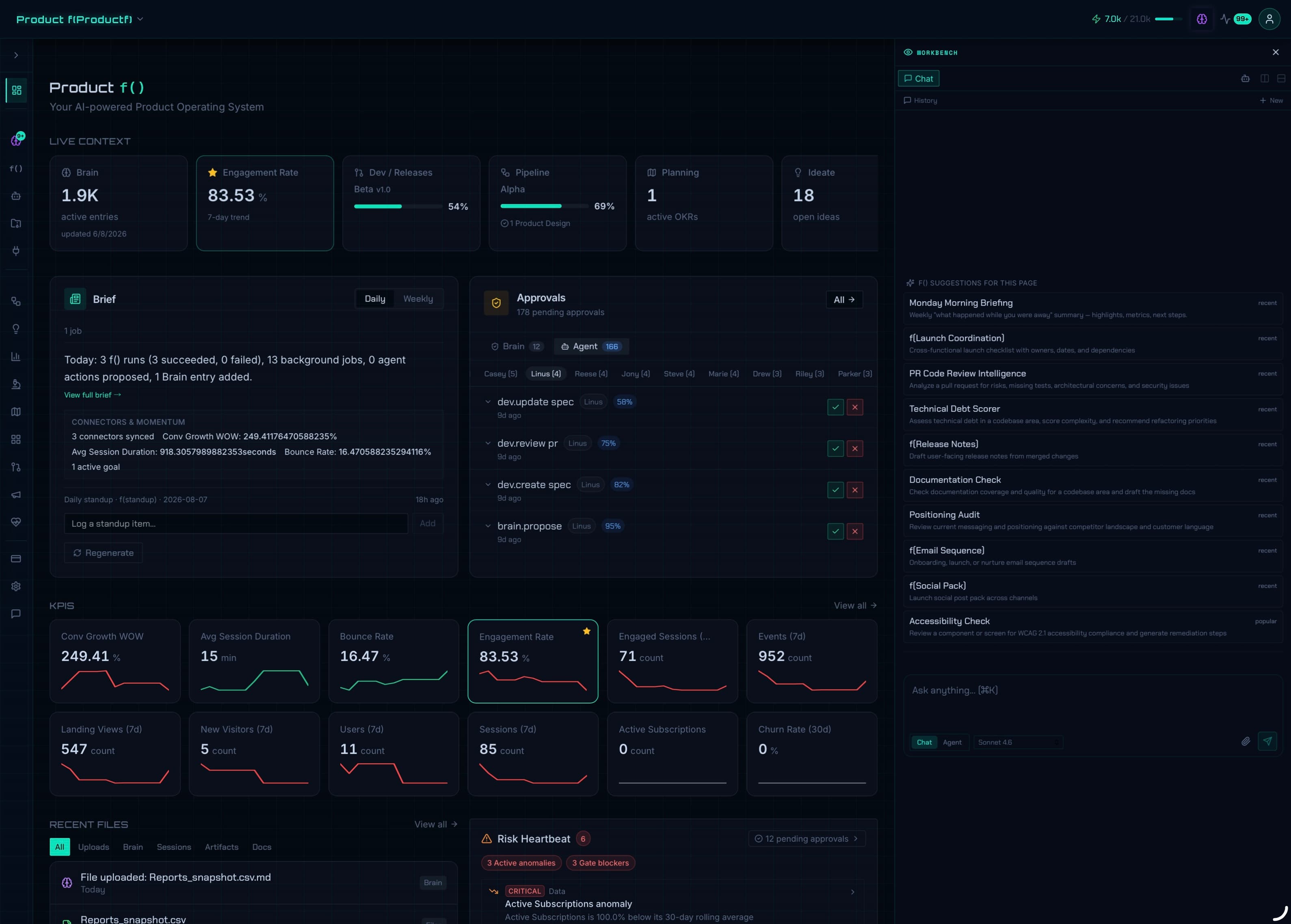
CommentsSelect any text in the thread to leave an inline comment on your next prompt.Dashboard & BrainYour workspace at a glance: briefs, risk signals, and the Brain's memory graph in one view.AgentsAutonomous agents that propose, never surprise. Every action routed through your confidence threshold.f() FunctionsEvery capability is a named, executable skill, one click away.ConnectorsPlug in your stack: GA4, GitHub, Slack, Notion, and 30+ more. The Brain starts learning immediately.Activity PanelEvery run, every read, every credit. A live feed of what your agents are actually doing.
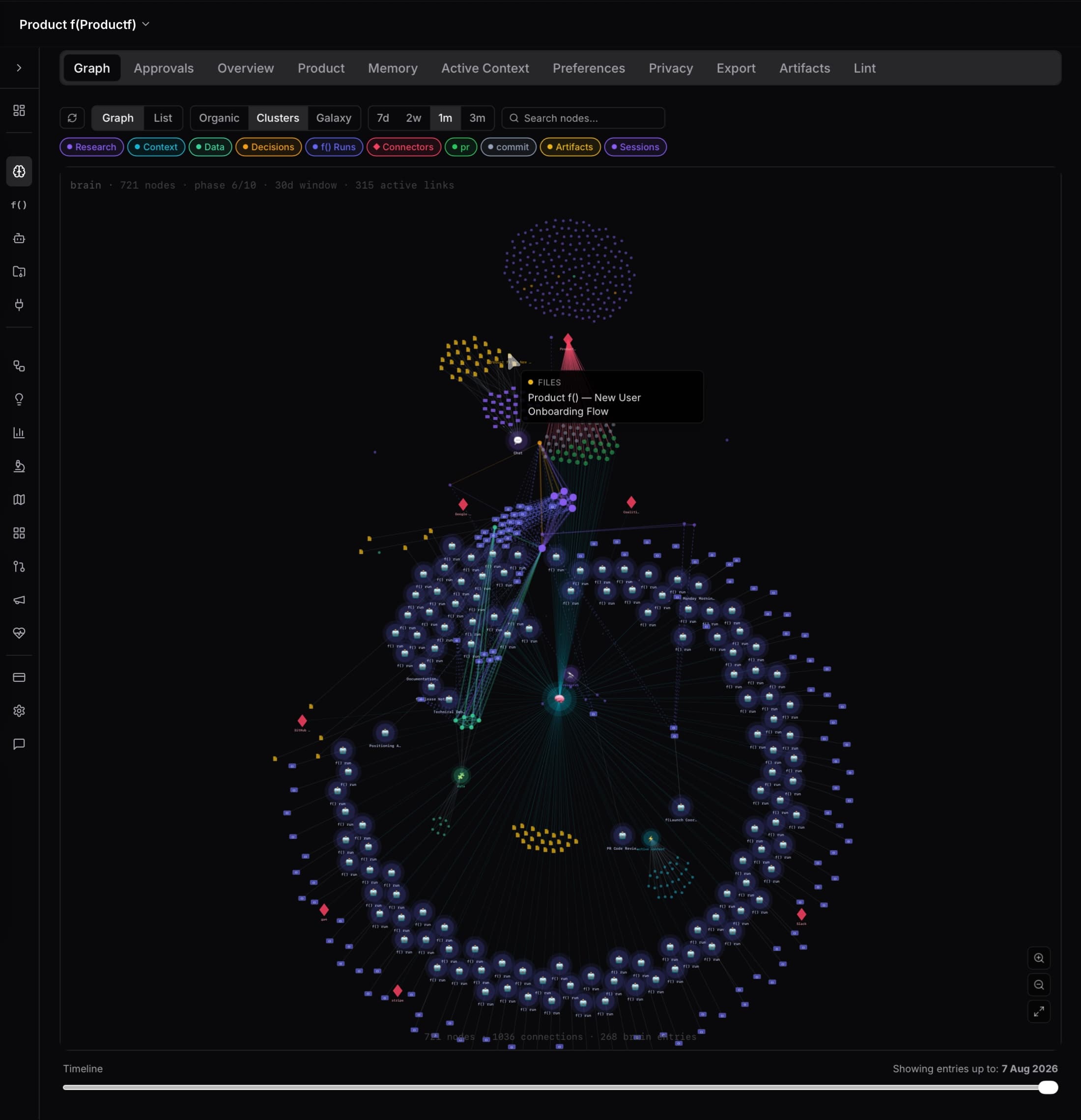
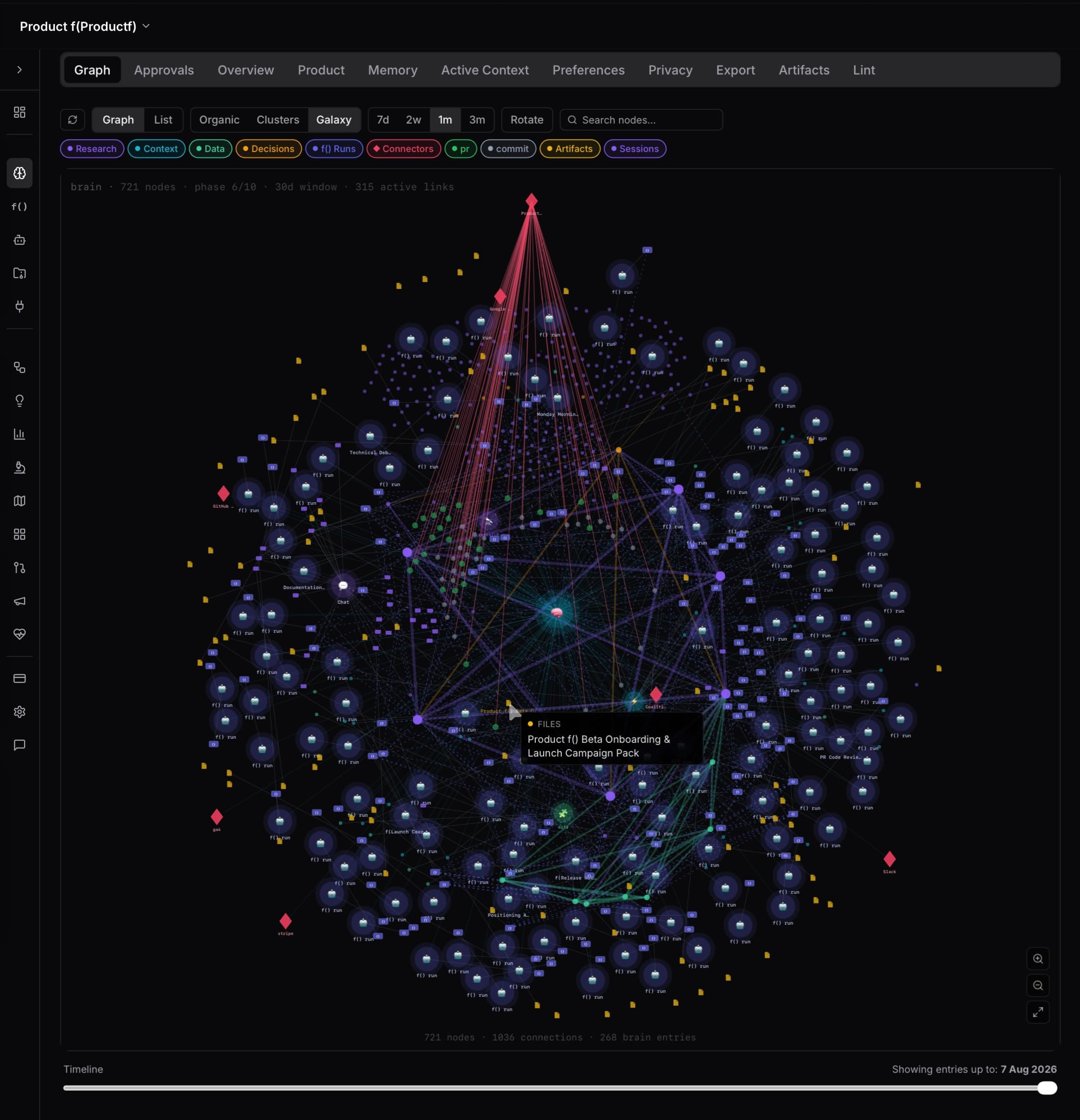
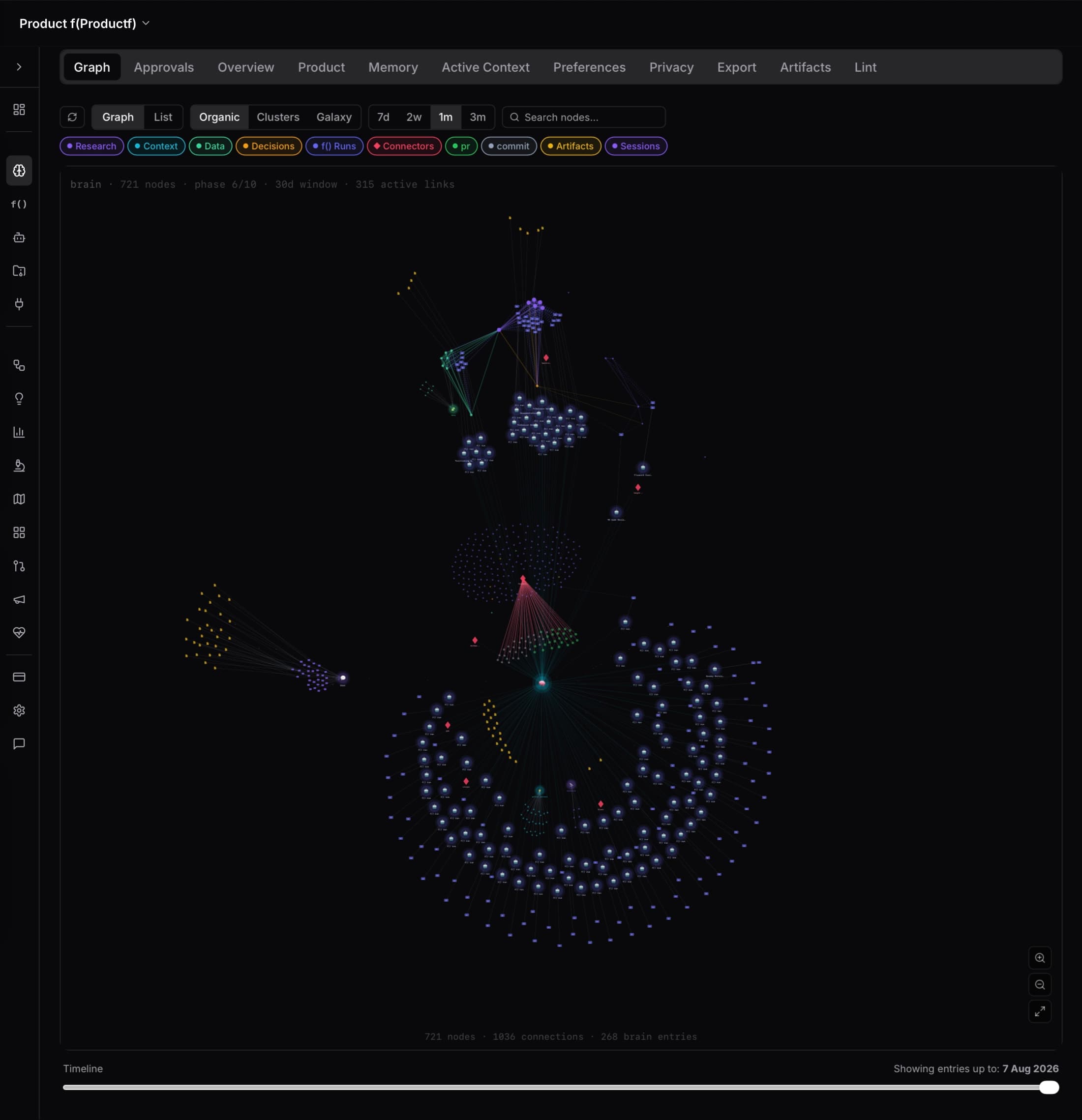
The BrainMemory that reorganizes itself: clusters, galaxy, or organic layout, however your team thinks about knowledge.
// the problem
AI gave product teams speed. It also gave them two new problems.
PROBLEM 01 / AMNESIA
It forgets everything, every time.
You re-explain your product to every tool. Last week's research, your KPI baselines, the call you already made, gone the moment the session ends. Brilliant AI, zero memory of your team.
› what's our activation baseline?‹ I don't have access to your product's data.‹ (so you paste it in. again.)
PROBLEM 02 / BLACK BOX
It's fast. Can you trust it?
The output looks confident. But you cannot see what it knew, what it assumed, or whether it is right. When it moves faster than you can check it, speed stops being a feature and becomes a risk.
‹ Ship v2.4 Friday. Readiness: high.› based on what?‹ (no source. no confidence. no checkpoint.)
GA4MixpanelNotionLinearSlackHubSpotJiraSheets
Eight tabs. Zero shared memory. Product f() replaces the scramble with one OS.
// the operating loop
Watch it catch one thing you would have missed.
These are runnable f() patterns, not feature promises: a real signal, start to finish, through five traceable stages. Pick a scenario and watch what the system saw, why it acted, and where you stay in control.
f(data) is watching activation, continuously, against your own baseline. Nobody had to ask. You were in another tab.
inngest · data-anomaly-check
f(data)ANOMALY
Activation dropped
42% to 31% · post-deploy · Mon
STAGE 02
It shows its sources
Before it answers it pulls your real baselines and the last time this happened, so the finding points to evidence, never a guess.
brain context · L0 to L2
STAGE 03
It knows when it is unsure
Every output gets a confidence score. High enough, it acts. In the grey zone, it brings the call to you.
0.78 → routed for review
confidence0.78
→ routed for review
STAGE 04
It checks with you before acting
Anything that leaves the building waits for your approval first. AI proposes, you decide.
HITL queue · class-2 action
⚑ NEEDS YOUR APPROVAL
Post the anomaly alert to #product-team? Evidence and Brain context attached.
STAGE 05
It remembers what you decided
Your call writes back to the Brain as a new node. Next Monday it already knows this pattern. The loop starts smarter.
brain write · +1 node
// the brain
The part that makes it compound.
A secure, persistent memory layer beneath every function. Nine kinds of context, injected only when a task needs them. Scroll, or drag the timeline, to watch it build.
Three themes, light or dark. Switch anytime in Settings.
Console, Dark
// open source cli
Your Brain, wherever you already work
npx @productf/cli bridges your workspace’s Brain into any MCP-speaking tool - Claude Desktop, Cursor, and more - over a secure hosted connection. No install, no server to run yourself.
› npx @productf/cli brain‹ connecting to your workspace Brain…‹ bridge ready - MCP tools live-synced from your instance
Every output is scored. At or above 0.85 it acts automatically. Between 0.60 and 0.85 it comes to you. Below 0.60 it is discarded.
discardreviewauto
0.600.85
It shows its work
Every answer carries the memory it used, the model that ran it, and its confidence. The sources panel is open by default, never buried.
sourced fromGA4Decision LogStripe
output
used byf(Weekly Pulse)
You set the leash
Choose oversight per task: let it run, review before it saves, or approve every step. Auto-approve the routine, hard-stop the irreversible.
Ask allReview exceptionsFully automated
AI proposes. You decide. The system logs why.
Speed without transparency is not a feature. It is a liability.
// who it's for
Built for anyone who needs to understand the product.
Product managers, founders, researchers, designers, engineers, support teams, and leaders get the same shared understanding - with the right depth for the work in front of them.
Product managers
Turn scattered signals into the next clear move.
Ask questions in plain language, draft PRDs from real evidence, and walk into planning and launch reviews with the context already connected.
Product leaders
Create one operating rhythm across every squad.
See the signals, decisions, and delivery work that matter without status theater. Keep strategy traceable from quarterly bets to what ships.
Founders & operators
Keep the company’s product memory in the company.
Make decisions with the evidence in reach, surface risks before they become incidents, and preserve the reasoning that compounds as the team grows.
Designers & researchers
Connect customer understanding to the work.
Bring interviews, comments, concepts, and validated insights into the same context as plans and decisions, so important details keep moving.
Engineers & technical leads
Make delivery context visible before execution.
Trace bugs, constraints, releases, and technical decisions back to the product intent. Spend less time reconstructing why and more time building.
Customer, growth & operations teams
Turn frontline signals into product learning.
Bring support patterns, churn risk, experiments, and operational feedback into the loop so the people closest to the customer can shape what happens next.